

Artificial intelligence has moved beyond simple chatbots and content generation. In 2026, nonprofits have an opportunity to use AI as part of the way work actually gets done, connecting people, data, documents, fundraising systems, communications, and decision-making.
That distinction matters.
Many nonprofit teams already use tools such as ChatGPT, Claude, Gemini, or Microsoft Copilot to write emails, summarize documents, brainstorm campaigns, or create social media content. But these are mostly individual AI tasks. The bigger opportunity is to build AI-powered workflows that repeatedly move work from one step to another with less manual effort.
A 2026 benchmark study of 346 nonprofits found that 92% were already using AI in some capacity, but only 7% reported major improvements in organizational capability. The study also found that 81% were using AI individually without shared workflows, while 47% had no AI governance policy.
The message is simple: having access to AI is no longer the challenge. Turning AI into repeatable organizational workflows is.
For nonprofits, this could mean spending less time moving information between spreadsheets, emails, documents, CRMs, and reporting systems, and more time working with donors, communities, volunteers, partners, and beneficiaries.
Below are ten enterprise AI workflows that nonprofits should consider building in 2026.
What Does “Enterprise AI Workflow” Mean for a Nonprofit?
Before looking at the workflows, it is important to define the term.
An enterprise AI workflow is a repeatable business or operational process in which AI is connected to an organization’s information, applications, and people to complete multiple steps of a task.
Instead of simply asking an AI chatbot:
“Write me a donor email.”
a workflow might look like:
Donor data → AI identifies donor context → AI prepares a personalized draft → staff reviews it → approved message is sent → response is recorded → future engagement is updated.
The AI is no longer just generating text. It is participating in a larger process.
That does not mean AI should make every decision automatically. In many nonprofit environments, human review remains essential, particularly when decisions involve beneficiaries, sensitive information, funding, eligibility, or public communications.
The goal is better described as:
AI handles repetitive work. People handle judgment, relationships, accountability, and decisions.
1. AI-Powered Grant Research and Proposal Workflow
Grant writing is one of the most time-consuming activities for many nonprofit organizations.
Teams have to identify potential funders, research eligibility requirements, monitor deadlines, review previous awards, understand priorities, prepare proposals, gather supporting information, and report on outcomes.
AI can turn this into a structured workflow.
How it works
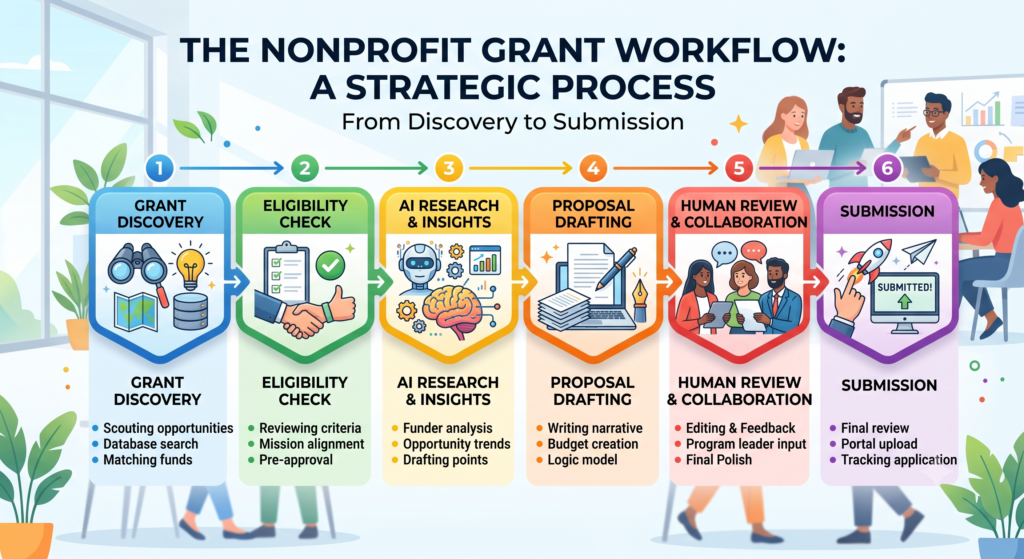
A nonprofit can create a workflow that:
- Monitors relevant grant opportunities.
- Extracts deadlines and eligibility requirements.
- Compares the opportunity with the organization’s programs.
- Identifies potential alignment.
- Creates a grant opportunity summary.
- Pulls relevant organizational information from approved documents.
- Creates a first draft of proposal sections.
- Identifies missing information.
- Routes the proposal to the appropriate staff member for review.
- Stores the final proposal and deadline in the organization’s system.
For example, if a nonprofit works in education, the system could flag a new foundation opportunity focused on digital learning.
Instead of a staff member spending hours searching and determining whether the grant is relevant, AI can provide a short briefing:
Grant: Digital Learning Initiative
Deadline: October 15
Eligibility: U.S. nonprofit organizations
Potential alignment: High
Relevant program: Community digital literacy
Missing information: 2025 program outcomes and beneficiary statistics
Recommended action: Program director review
The staff member still makes the final decision.
Why this matters
The value isn’t simply generating a proposal faster.
It is reducing the amount of administrative work required to discover and prepare funding opportunities.
2. Donor Intelligence and Personalized Engagement
Donor relationships are one of the most important assets a nonprofit has.
But donor information often exists across multiple systems:
- CRM records
- Donation history
- Event attendance
- Email engagement
- Volunteer activity
- Campaign participation
- Notes from development officers
- Previous communications
AI can help bring this information together.
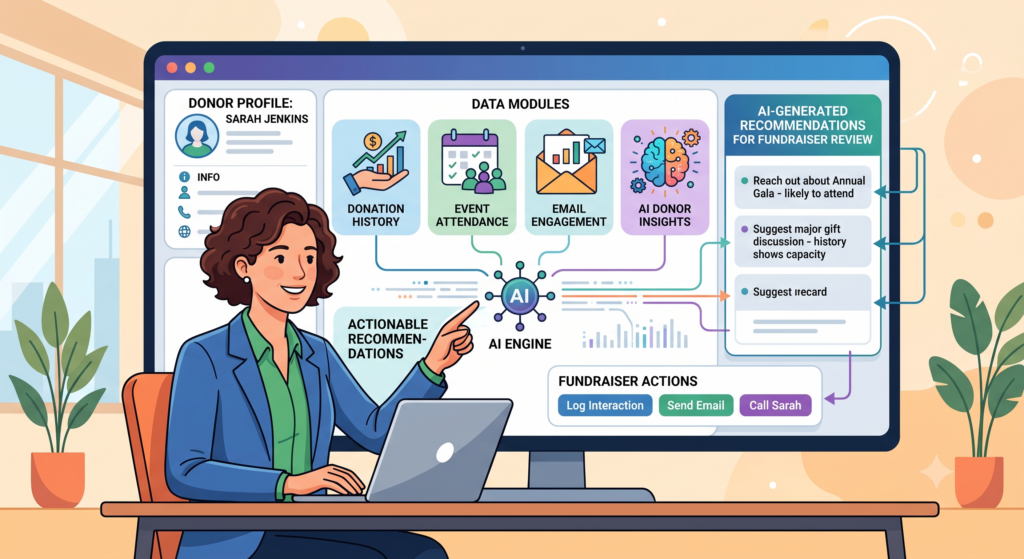
A donor intelligence workflow could analyze approved donor data and create useful summaries for fundraising teams.
For example:
“This donor has supported the organization for six years, increased annual giving twice, attended three fundraising events, and recently engaged with education-related communications.”
That gives a development officer context before contacting the donor.
AI can also help identify donor segments based on engagement patterns and prepare personalized communication suggestions.
But personalization should not mean sending hundreds of automatically generated messages.
The better model is:
AI identifies context → AI recommends an approach → fundraiser reviews → human communication happens.
Recent 2026 nonprofit research shows that organizations are increasingly using AI for donor research and engagement, while many fundraisers remain cautious about using generative AI directly in donor communications.
That caution is healthy.
Donors are people, not data points.
3. AI-Powered Donor Retention Workflow
Getting a first donation is only part of fundraising.
Keeping donors engaged over time is often even more important.
An AI workflow can monitor donor engagement signals and identify people who may be becoming less active.
For example:
Donation frequency ↓
Email engagement ↓
Event attendance ↓
Volunteer participation ↓
The system could flag the donor for review.
Instead of automatically sending a generic “We miss you” email, the workflow could provide the fundraising team with context:
“This donor has contributed annually for four years but has not donated this year. Their previous giving was connected to the youth education program.”
The fundraiser can then decide how to reconnect.
The workflow could also recommend appropriate next steps based on the donor’s previous relationship with the organization.
This turns AI into an early-warning system for donor relationships.
It helps fundraising teams focus their limited time on relationships that need attention.
4. Volunteer Recruitment and Coordination Workflow
Volunteers are essential to many nonprofits, but managing them can create substantial administrative work.
Applications arrive through forms, email, websites, events, and referrals.
Someone then has to:
- Review applications
- Understand interests
- Check availability
- Match skills
- Schedule volunteers
- Send reminders
- Answer questions
- Track participation
An AI workflow can assist with much of this process.
Example
A volunteer applies and says:
“I am available on weekends and have experience teaching children.”
AI can categorize the application and compare it with available opportunities.
The system could recommend:
Volunteer: Candidate A
Skills: Education, mentoring
Availability: Saturday
Potential opportunity: Community tutoring program
Match: High
A coordinator reviews the recommendation before the volunteer is assigned.
AI can also answer routine volunteer questions using approved organizational information.
This creates a useful combination:
AI for coordination + humans for relationship management.
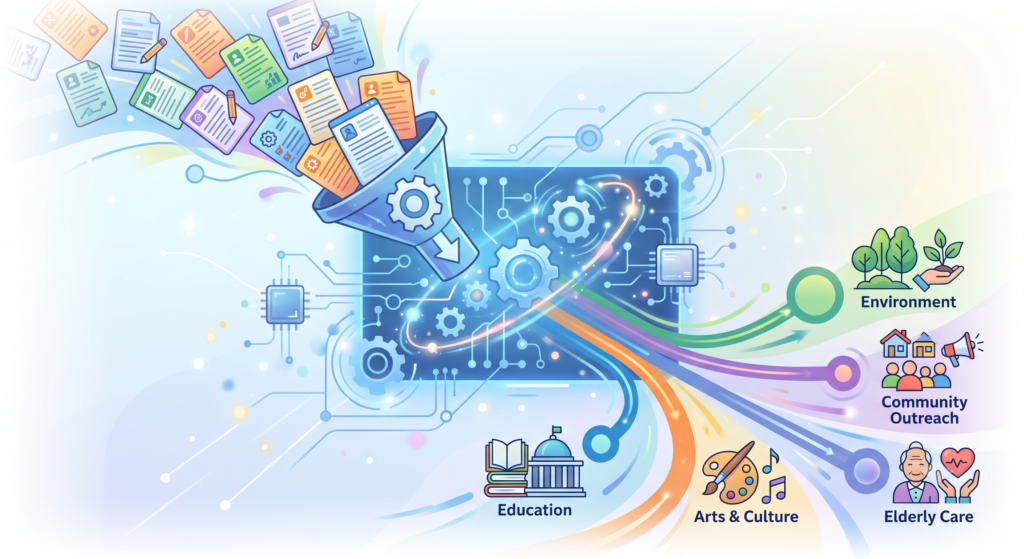
5. Program Impact and Outcome Analysis
Nonprofits collect enormous amounts of information about their programs.
The challenge is often not collecting data.
It is understanding it.
A nonprofit might have:
- Survey responses
- Attendance records
- Beneficiary feedback
- Program statistics
- Case notes
- Financial information
- Geographic data
- Outcome measurements
AI can help analyze these datasets and turn them into understandable insights.
For example:
“Participation increased by 18% compared with the previous quarter, but completion rates declined among first-time participants.”
That insight can lead to a better question:
Why?
AI can help identify patterns for staff to investigate.
The important distinction is that AI should not be treated as the final authority on program impact.
Instead:
Data → AI analysis → Human interpretation → Program decision
This is particularly important when data concerns vulnerable communities.
6. Automated Impact Reporting
Nonprofits regularly need to report results to:
- Grantmakers
- Foundations
- Government agencies
- Corporate partners
- Boards
- Donors
- Internal leadership
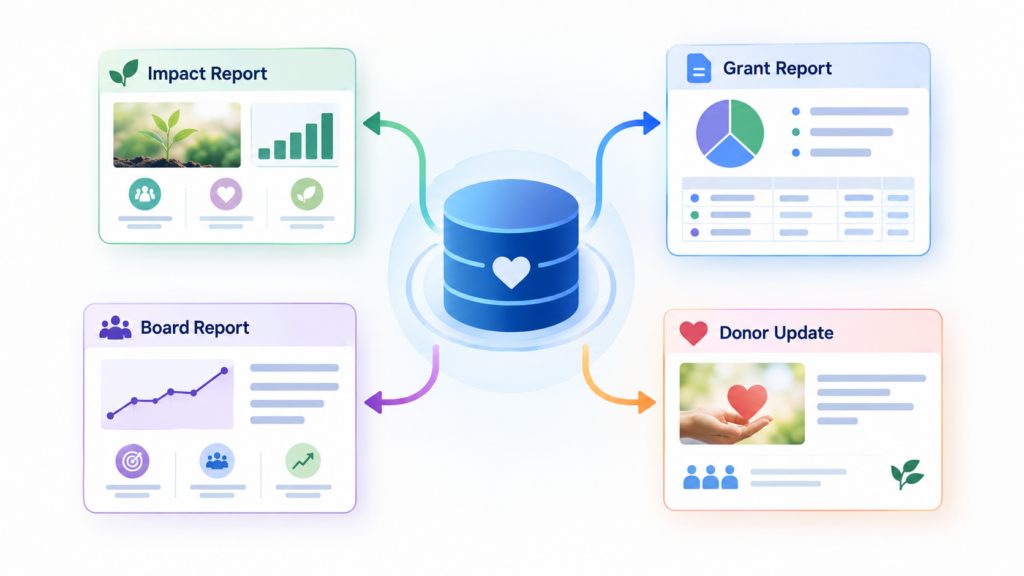
The same information may have to be presented in several different formats.
An AI workflow can connect approved program data with reporting templates.
For example:
Program database → outcome data → AI-generated draft → supporting evidence → staff review → final report
The system could prepare a first draft containing:
- Program activities
- Number of participants
- Outcomes
- Progress against goals
- Challenges
- Success stories
- Financial information
- Next steps
Staff members then verify the numbers, add context, and approve the final report.
This can significantly reduce repetitive reporting work.
More importantly, it can help organizations maintain a consistent record of their impact throughout the year rather than reconstructing everything when a report deadline arrives.
7. AI-Powered Knowledge Management
One of the most overlooked AI opportunities for nonprofits is internal knowledge.
Organizations accumulate years of information:
- Policies
- Grant applications
- Board documents
- Program manuals
- Research
- Meeting notes
- Communications
- Training materials
- Standard operating procedures
- Historical reports
Finding the right information can become difficult.
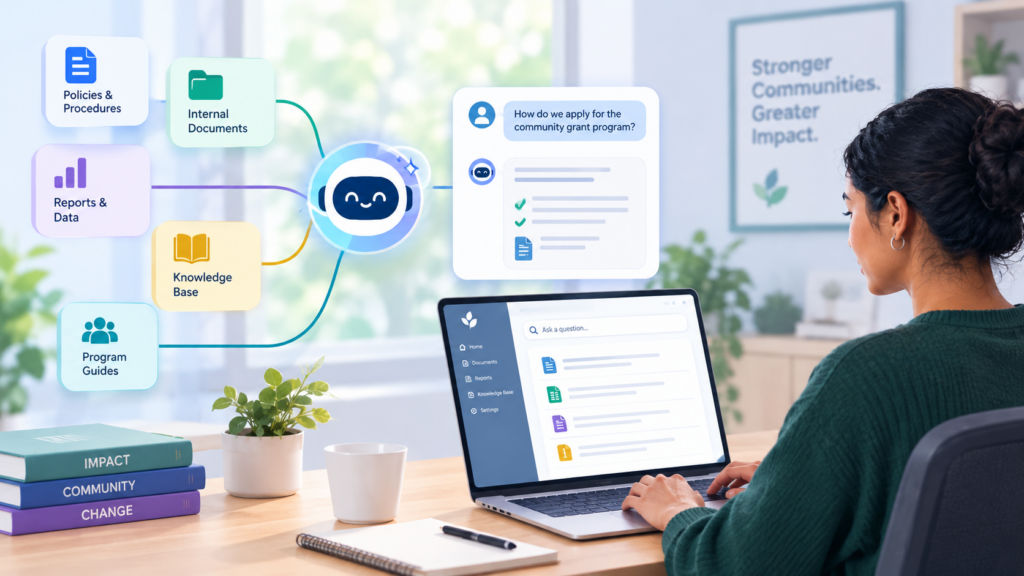
An internal AI knowledge assistant can allow staff to ask questions using natural language.
For example:
“What is our current volunteer onboarding process?”
or:
“What outcomes did our 2025 education program report?”
or:
“Which grant proposals did we submit last year for youth development?”
Instead of searching through folders and emails, employees can receive answers based on approved internal documents.
This can be particularly valuable when employees leave an organization.
Their knowledge does not have to leave with them.
8. AI-Powered Communications Workflow
Nonprofits communicate with many different audiences.
The same program may need to be explained differently to:
- Donors
- Volunteers
- Grantmakers
- Board members
- Community members
- Journalists
- Corporate partners
AI can help adapt approved content for each audience.
For example:
Original program update
↓
AI creates:
- Donor newsletter
- Website update
- Social media post
- Board summary
- Grant report paragraph
- Volunteer update
The workflow should begin with approved source information.
That reduces the risk of AI inventing facts.
A communications team can then review the outputs before publishing.
This is more powerful than simply asking ChatGPT to “write five social media posts.”
The organization is creating a repeatable content production system.
9. AI Assistant for Beneficiary and Community Support
This workflow requires the greatest care.
Some nonprofits interact directly with people seeking:
- Housing assistance
- Food assistance
- Education
- Healthcare
- Legal support
- Employment assistance
- Crisis resources
- Community services
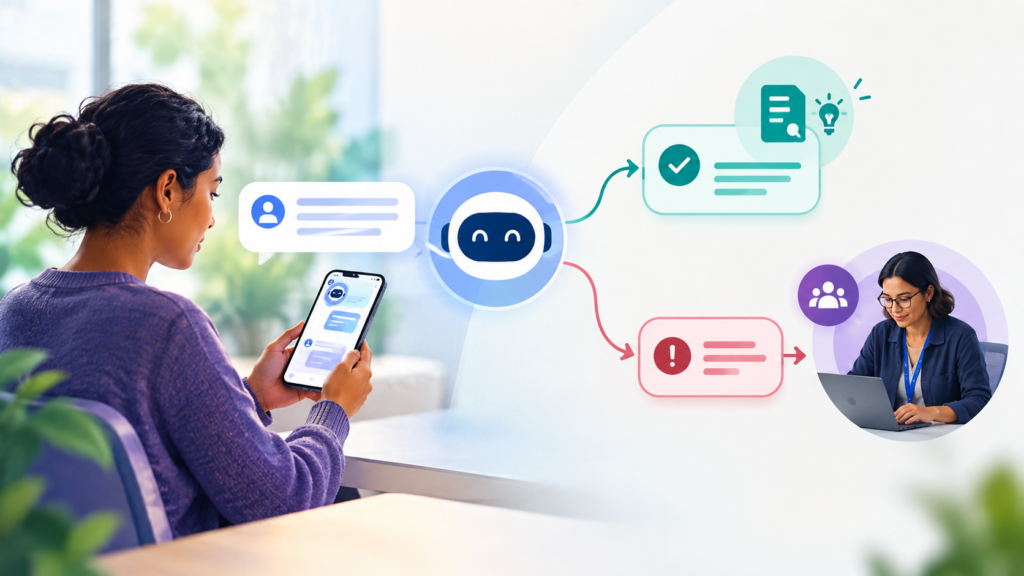
AI can help with routine information and navigation.
For example, a community member might ask:
“What documents do I need to apply for this program?”
An AI assistant could provide information based on approved organizational resources.
It could also help people find relevant programs, translate information, or provide multilingual access.
But the system should have clear boundaries.
It should know when to say:
“This requires a staff member.”
Sensitive cases, eligibility decisions, crisis situations, legal decisions, medical decisions, or situations involving vulnerable individuals should be escalated to qualified humans.
The objective is not to replace the human relationship.
It is to make it easier for people to reach the right person.
10. AI-Powered Executive and Board Intelligence
Nonprofit executives and boards have to make decisions using information from many parts of the organization.
That information might include:
- Financial performance
- Fundraising
- Program outcomes
- Volunteer activity
- Donor retention
- Grant pipeline
- Operational issues
- Community feedback
Instead of reviewing dozens of reports separately, leadership could have an AI-generated organizational briefing.
For example:
Monthly nonprofit intelligence briefing
Fundraising
- Donations are 8% below target.
- Recurring giving remains stable.
- Major donor activity increased.
Programs
- Participation increased.
- One program has lower completion rates.
Operations
- Volunteer capacity is below target.
Risk
- Two major grants require renewal within 60 days.
Recommended discussion
- Donor retention strategy
- Program completion issue
- Upcoming grant renewals
The AI is not making decisions for the board.
It is helping the board spend more time making decisions instead of assembling information.
The Bigger Opportunity: Connecting the Workflows
The real value appears when these workflows stop operating independently.
Imagine a nonprofit where:
Grant research identifies a new opportunity.
↓
The system finds relevant program data.
↓
AI helps prepare the grant proposal.
↓
The proposal is approved and submitted.
↓
Program results are captured.
↓
AI helps prepare the impact report.
↓
The report becomes part of the organization’s knowledge base.
↓
Relevant results are turned into donor communications.
↓
Donor engagement is tracked in the CRM.
↓
Leadership receives an organizational intelligence briefing.
That is no longer “using ChatGPT.”
That is an AI-enabled operating model.
Why Nonprofits Should Not Automate Everything
There is a temptation in 2026 to treat AI automation as the ultimate goal.
It isn’t.
A nonprofit exists to serve people and communities. Efficiency matters, but it is not the mission by itself.
There are situations where automation is appropriate:
- Summarizing documents
- Categorizing information
- Drafting repetitive communications
- Finding patterns in large datasets
- Preparing reports
- Organizing information
- Routing routine questions
- Identifying potential opportunities
There are other situations where human involvement should remain central:
- Decisions affecting beneficiaries
- Sensitive donor relationships
- Ethical decisions
- Crisis situations
- Public statements
- Program strategy
- Funding decisions
- Interpretation of ambiguous data
A useful principle is:
Automate the process, not the responsibility.
AI can make work faster.
People remain accountable for what the organization does with that work.
Building an AI Workflow: A Simple Framework for Nonprofits
Nonprofits don’t need to build all ten workflows at once.
A better approach is to start with one repetitive process.
Step 1: Identify the bottleneck
Ask:
What task consumes a lot of staff time but doesn’t require much judgment?
That is often a good AI workflow candidate.
Step 2: Map the current process
Write down every step.
For example:
Grant opportunity arrives → staff reads it → checks eligibility → researches funder → searches previous proposals → drafts response → gets review → submits.
Step 3: Identify where AI can help
AI might handle:
- Research
- Summarization
- Categorization
- Drafting
- Data analysis
- Information retrieval
Step 4: Keep humans at decision points
Mark where someone must review or approve the result.
Step 5: Connect the right systems
The workflow may involve:
- CRM
- Google Workspace
- Microsoft 365
- Grant databases
- Accounting systems
- Forms
- Project management platforms
- Internal knowledge bases
The exact tools matter less than how they connect.
Step 6: Measure the result
Don’t measure success by saying:
“We are using AI.”
Measure things such as:
- Hours saved
- Faster response time
- Number of opportunities reviewed
- Donor retention
- Staff capacity
- Reporting time
- Volunteer response time
- Program insights generated
- Errors reduced
The question should always be:
Did this improve our ability to achieve our mission?
AI Governance Should Be Part of the Workflow
As nonprofits move from individual experimentation to organizational AI, governance becomes increasingly important.
A basic nonprofit AI policy should answer questions such as:
- What information can employees enter into AI systems?
- What information is confidential?
- Which AI tools are approved?
- When is human review required?
- Who owns AI-generated content?
- How should AI-generated information be verified?
- What happens when AI produces an incorrect answer?
- Which decisions can never be automated?
This is becoming increasingly important as AI moves into more sensitive organizational processes.
The 2026 nonprofit AI adoption research found that 47% of surveyed organizations had no AI governance policy.
For nonprofits, governance should not be treated as paperwork that comes after implementation.
It should be built into the workflow from the beginning.
Start Small, But Think Enterprise
A small nonprofit does not need a massive AI transformation project.
The first workflow could be something as simple as:
New grant opportunity → AI summary → eligibility check → staff review
Another organization might start with:
New donor activity → AI-generated donor briefing → fundraiser review
Another might begin with:
New volunteer application → AI categorization → coordinator review
Once one workflow works reliably, the organization can expand.
The important change is moving from:
“Everyone can use AI.”
to:
“Our organization knows where AI fits into the way we work.”
That is the difference between AI experimentation and AI adoption.
The Future of AI in the Nonprofit Sector
The next stage of nonprofit AI will not be defined simply by which organization has access to the best chatbot.
It will be defined by how effectively organizations connect AI to their existing work.
In 2026, nonprofits are already moving in this direction. Recent sector research shows widespread AI adoption, but also a significant gap between using AI for small efficiency gains and embedding it into organizational workflows that produce measurable impact.
That gap represents an opportunity.
For organizations with limited staff and budgets, the ability to reduce repetitive work can create meaningful additional capacity. A few hours saved each week across fundraising, reporting, communications, volunteer coordination, and administration can become hundreds of hours over a year.
But the strongest nonprofit AI strategy will not be:
“How can we replace more work with AI?”
It will be:
“How can we give our people more capacity to do the work only people can do?”
That means stronger donor relationships.
Better community engagement.
More time for program development.
Faster access to organizational knowledge.
Better decisions.
And ultimately, more time focused on the mission.
Conclusion
ChatGPT and other generative AI tools are only the starting point.
The bigger opportunity for nonprofits in 2026 is to build repeatable, connected AI workflows around the organization’s most important processes.
From grant research and donor intelligence to volunteer coordination, impact reporting, knowledge management, community support, and board intelligence, AI can become part of the nonprofit’s operating infrastructure.
The organizations that benefit most will not necessarily be the ones using the most AI tools.
They will be the ones that carefully identify where AI can remove repetitive work, connect fragmented information, support better decisions, and give people more time to focus on their mission.
Beyond ChatGPT, the future is not just AI that answers questions. It is AI that helps organizations get meaningful work done.