


From Silicon Valley to Foley Square: Mapping U.S. AI Copyright Risk Across the Value Chain
Whose intelligence is it, anyway? That is the question beneath the U.S. copyright cases now testing generative AI, and it leads to an even harder one: what does AI owe, if anything, to the human sources that helped make its intelligence possible?
The emerging U.S. law does not answer those questions with a single rule for “AI copying.” It is drawing separate legal lines across the AI value chain. How content was acquired, retained, used for training, retrieved, reproduced in outputs, stripped of attribution or license information, and deployed into existing markets can trigger different rights, defenses, evidence, and remedies.
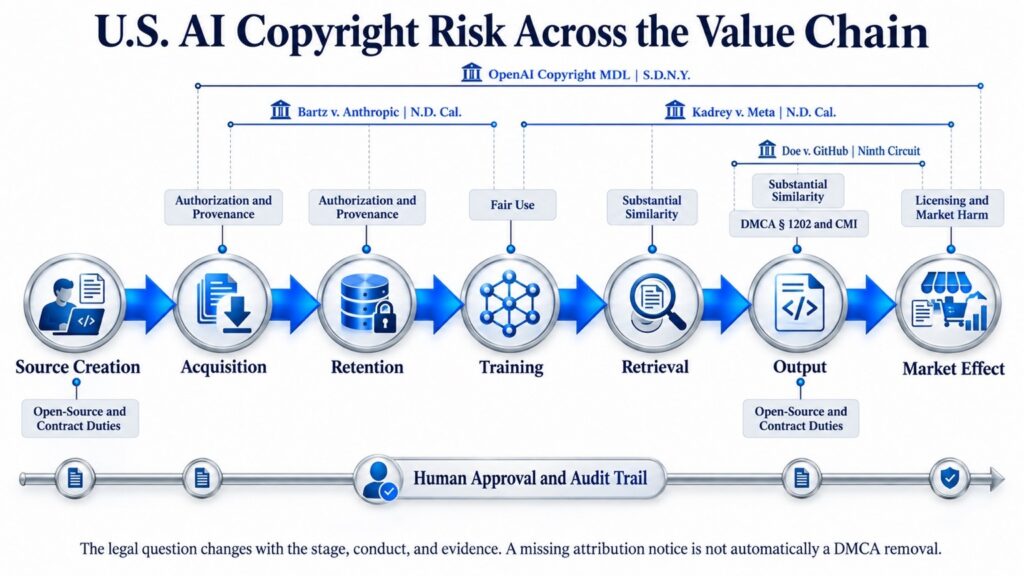
The central thesis is straightforward: U.S. AI copyright risk must be governed stage by stage. A company can win on one theory and remain exposed on another because infringement, fair use, Section 1202, and license compliance raise distinct but overlapping questions, with market harm informing the fair-use analysis. Provenance, licensing, output testing, attribution controls, and a documented human audit trail are therefore part of the legal architecture, not merely operational good practice.

The Ninth Circuit has now supplied the first federal appellate precedent in that map. In Doe v. GitHub, the court rejected an output-based DMCA theory involving GitHub Copilot and OpenAI Codex, but the decision’s significance is broader than a single dismissed claim. It establishes the first appellate framework for asking when an AI output has actually “removed or altered” protected copyright-management information, while leaving training fair use, ordinary infringement, substantially similar outputs, and open-source license obligations to their own doctrines and evidence.
The Ninth Circuit draws the first appellate line
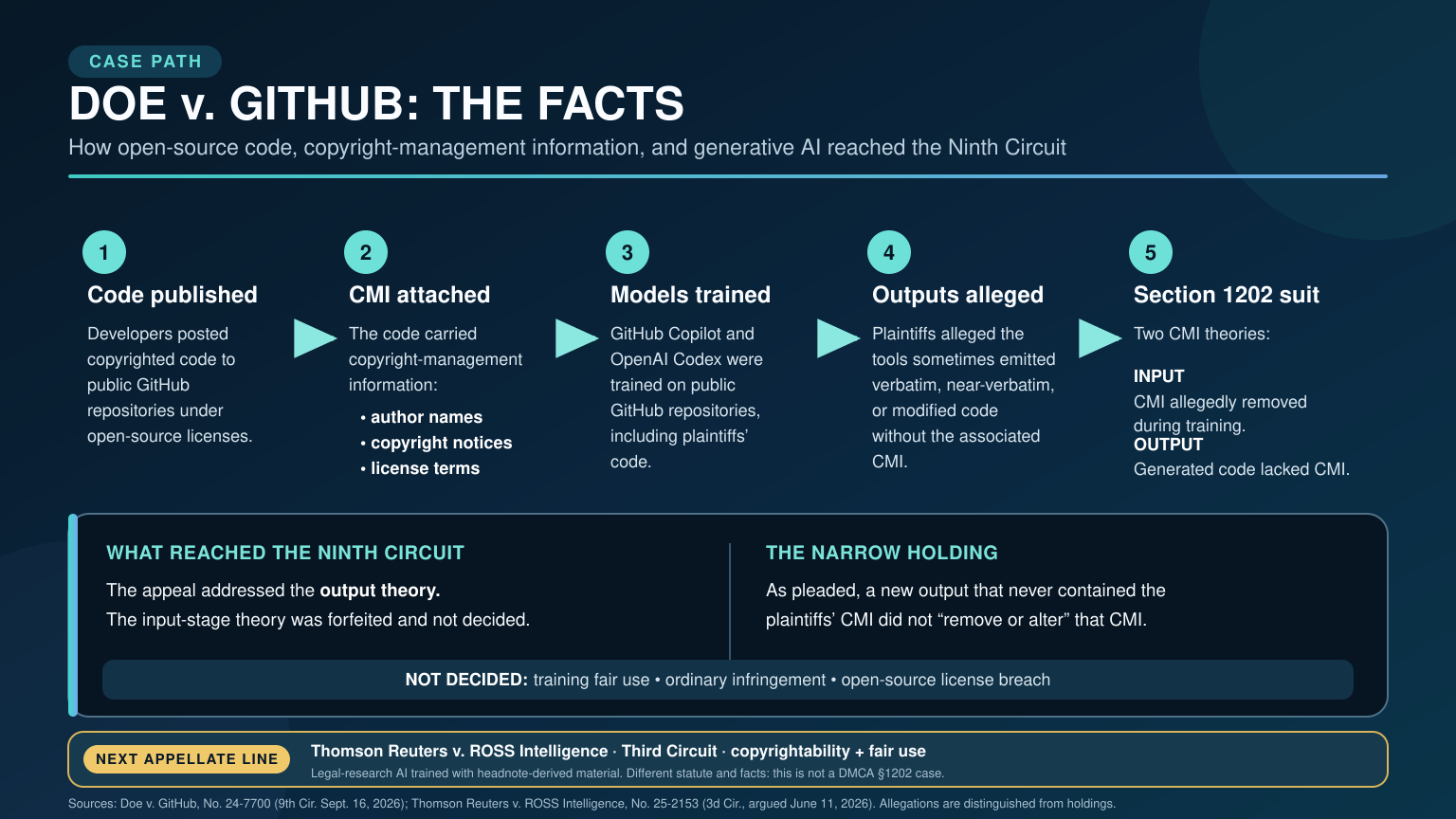
The developers in Doe alleged that publicly available code hosted on GitHub contained copyright-management information, or CMI, such as authors’ names, notices, and license terms. They argued that Copilot and Codex could generate code based on that material without reproducing the associated CMI, violating Section 1202(b).
On September 16, 2026, the Ninth Circuit affirmed dismissal of that output-based theory. The court held that when a generative system creates a new output that never contained the plaintiff’s CMI, the system has not “removed or altered” CMI from a work or copy within the meaning of the statute. The court treated ‘identicality’ as something of a misnomer, explaining that it is a gloss on the statutory terms rather than an independent requirement. The operative question is statutory: whether protected information was actually removed or altered from the work or copy at issue. A near-total reproduction with cosmetic changes may still present a different case from a genuinely new output.
A key passage from the court’s opinion:
“Turning to the merits of the output theory, we agree with the district court that the complaint does not state a claim under the DMCA. The complaint describes an AI tool that does not look up and reproduce stored work but rather creates new work. That new work may or may not infringe plaintiffs’ copyrights in their code, but it cannot reasonably be described as a copy of that code from which CMI has been ‘removed’ or ‘altered.’”
Doe v. GitHub, Inc., No. 24-7700, slip op. at 13 (9th Cir. Sept. 16, 2026).
The decision matters for three reasons. First, it is the first federal appellate opinion to address a generative-AI CMI theory, making it binding throughout the Ninth Circuit and influential elsewhere. Second, it blocks an expansive theory under which every unattributed AI output influenced by protected code could become a DMCA violation. Third, it directs litigants toward the precise event and evidence that the statute regulates, rather than treating training, generation, attribution, and infringement as interchangeable.
There are equally important limits. The developers’ alternative theory that CMI was removed when source code was ingested for training was not decided because the Ninth Circuit found it forfeited. The panel did not decide whether training was fair use, whether a substantially similar output infringed, or whether open-source license terms were breached. Contract-based license claims also remain in the district court litigation.
DMCA and infringement ask different questions
Section 1202 and ordinary copyright infringement protect related interests, but they require different proof.
An infringement claim asks whether the plaintiff owns a valid copyright and whether protected elements of the work were copied. Authorization and defenses such as fair use are separate questions. In an output case, substantial similarity and protectable expression may be central. In a training case, courts may examine the purpose of intermediate copies, the nature and amount of the works used, and actual or likely market harm.
A Section 1202 claim asks whether CMI was intentionally removed or altered without authority, or whether a work or copy was distributed knowing that CMI had been removed or altered without authority. In either event, civil liability also requires knowledge, or reasonable grounds to know, that the conduct will induce, enable, facilitate, or conceal infringement. Attribution matters, but omission alone is not necessarily removal. Doe therefore does not declare AI training lawful or unattributed outputs harmless. It defines one statutory boundary and makes the chain of proof more exacting.
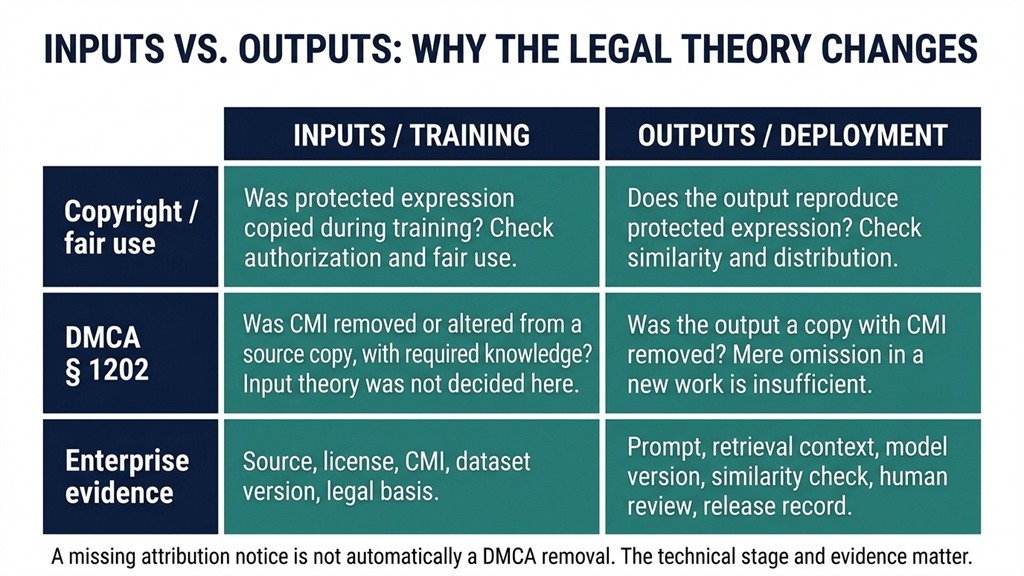
That distinction should also shape enterprise governance. A system may present low Section 1202 risk and still create infringement, contract, open-source, confidentiality, or reputational risk. The legal label changes with the conduct and the stage of the system.
Five cases, five different legal battlegrounds
| Case and court | Legal focus | Status as of Sep. 18, 2026 | What remains open |
| Doe v. GitHub (9th Cir., 2026) | DMCA § 1202 and CMI in AI outputs | On Sep. 16, the court affirmed dismissal of the output-CMI claim. This is the first federal appellate precedent on a generative-AI CMI theory. | The input-stage CMI theory was forfeited. Fair use, infringement, and open-source license questions were not decided. |
| Thomson Reuters v. ROSS Intelligence Third Circuit | Copyrightability, non-generative AI training, fair use, and direct market competition | The District of Delaware granted Thomson Reuters partial summary judgment, held that ROSS infringed 2,243 Westlaw headnotes, and rejected fair use. The Third Circuit heard oral argument on June 11, 2026; no opinion has issued. | Whether the headnotes are sufficiently original to receive copyright protection, and whether using headnote-derived training material to build a competing legal-research system was fair use. |
| Bartz v. Anthropic (N.D. Cal., 2025) | Acquisition versus training fair use | The training use was fair use; that ruling did not excuse the separate acquisition and retention of pirated central-library copies. The $1.5 billion settlement received final approval July 20. | No appellate merits review. The ruling remains influential but the settlement resolved the class claims. |
| Kadrey v. Meta (N.D. Cal., 2025) | Training fair use and market harm | Meta won summary judgment on the training claim on the record presented. Interlocutory appeal was denied July 8. | A better-supported market-dilution theory, plus separate distribution and contributory-infringement issues. |
| In re OpenAI Copyright Litigation (S.D.N.Y., ongoing) | Books and News tracks: training, outputs, retrieval, markets, and DMCA | Cross-motions for summary judgment were filed Sep. 4. DOJ filed Sep. 1. No merits decision has issued. | The treatment of acquisition, output evidence, licensing markets, retrieval, and alleged market substitution. |
California separates acquisition, training, and proof

The two major Northern District of California book cases show why “training is fair use” is too crude a summary.
In Bartz v. Anthropic, Judge William Alsup held that using books to train large language models was highly transformative and fair use. But he treated acquisition and retention for Anthropic’s central library as separate acts. Anthropic’s alleged downloading of millions of books from pirate libraries was not excused merely because the company later used some of those files for a transformative training purpose. The case settled for $1.5 billion, and the court granted final approval on July 20, 2026. The settlement resolved the class claims without appellate review of the fair-use ruling.
In Kadrey v. Meta, Judge Vince Chhabria granted Meta summary judgment on the training claim based on the record the plaintiffs developed. He emphasized that the plaintiffs had not presented meaningful evidence of market harm. At the same time, the opinion recognized that AI systems capable of producing enormous volumes of competing material could support a stronger market-dilution theory in another case. The court later denied interlocutory appeal on July 8, 2026. Distribution-related claims concerning alleged torrenting and sharing have continued to present distinct questions.
Bartz and Kadrey are often placed in the same “AI training is fair use” bucket. Their more useful lesson is methodological. Acquisition can be unlawful even when a later use is transformative. Transformation does not eliminate the fourth factor. And market harm must be proved with evidence tied to a legally cognizable market, not assumed from scale alone. The courts nevertheless differ on how training’s purpose bears on acquisition and whether noninfringing competing outputs can cause legally cognizable market harm.
Foley Square is testing the fuller record

The consolidated OpenAI copyright litigation in the Southern District of New York places those questions before one court on a much broader record. In April 2025, the Judicial Panel on Multidistrict Litigation centralized twelve actions before Judge Sidney H. Stein. The cases proceed on separate Books and News tracks because the works, product behavior, alleged market injuries, and remaining claims differ.
The Books plaintiffs focus on alleged shadow-library acquisition, training copies, model capabilities, output evidence, and the market for authorial works. The News plaintiffs add journalism-specific concerns, including retrieval-augmented generation, publisher traffic, subscription and licensing markets, attribution, and alleged substitution by answer products. OpenAI and Microsoft dispute liability and argue, among other things, that training is transformative and that many asserted harms are too remote from the rights copyright protects.
The parties filed summary-judgment motions on September 4, 2026. The court has not yet decided fair use or the merits. The Department of Justice filed a Statement of Interest on September 1. DOJ described training as potentially “exceedingly transformative,” urged the court to separate training from infringing or reconstructive outputs, and cautioned against an overbroad market-dilution theory that could give copyright owners control over lawful competition. The filing is influential but not binding, and the plaintiffs’ records and responses remain central.
This East Coast record is not simply a rematch of the West Coast cases. It tests whether different evidence about acquisition, retrieval, output behavior, licensing, and market effects changes the analysis. The rivalry is doctrinal, not geographic: Silicon Valley has supplied early lines, while Foley Square is being asked to decide how those lines operate across a fuller AI system.
Licensing is turning market harm into market design
The fourth fair-use factor is becoming more concrete as publishers, record labels, platforms, and model developers enter training and content licenses. Those agreements matter because they can show that a market for permission is not hypothetical. They also create price signals, technical conditions, attribution terms, and allocation rules that courts may have to evaluate.
For a closer look at how negotiated licenses are reshaping AI strategy, see Lights, Camera, Licensing: How Disney and Warner Are Rewriting the AI Playbook.
But the existence of a deal does not automatically answer fair use. Courts must still distinguish a traditional or reasonably likely licensing market from a market defined only by a rights holder’s desire to charge for any use. They must also separate direct substitution by outputs from broader competition created by a capable new technology.
This is where the legal cases become a governance problem. If organizations cannot identify which sources entered a system, under what rights, at which stage, and with what downstream controls, they will struggle to prove lawful acquisition, honor license terms, preserve CMI, investigate outputs, or quantify market effects.
What general counsel should do now
The emerging rule is not that AI companies always win or that creators always lose. It is that courts are demanding stage-specific claims, evidence, and controls.
General counsel should require an auditable record of source acquisition, retention, training authorization, retrieval design, output testing, attribution logic, and remediation. Human review should be assigned at the points where legal character can change: accepting data, approving a training use, deploying retrieval, escalating similarity findings, responding to rights-holder notices, and changing a model or product after discovery of a problem.

Contracts should also separate the risks. Training-data rights, CMI handling, open-source compliance, output warranties, indemnities, audit access, incident cooperation, and preservation duties are not interchangeable. A vendor’s representation about training does not answer whether a customer-facing output reconstructs protected material or violates a license.
Whose intelligence is it, anyway? Legally, no single case can assign ownership across the entire stack. But the cases are beginning to assign obligations to particular stages of the system. What AI owes its sources will be shaped not only by appellate doctrine, but by the licenses, product choices, audit trails, and human decisions organizations make now.
Separate the stages. Preserve the evidence. Govern the handoffs.
Continue the conversation: Join IntelCraft Office Hours for a practical discussion of what these cases mean for AI governance, copyright controls, and the human decisions across the AI value chain.
Register here
Further reading
- The Wild West of AI Ownership
- Can We Stop Comparing AI to Napster?
- From “RAGs” to Output Riches: The Next Frontier in AI Copyright Law
- When the Dominoes Fall: What the Anthropic Settlement and Apple’s New Lawsuit Mean for AI Copyright
- When AI Creates Value, Settlements Aren’t Arm’s Length — They’re Arm’s Twist
- Dominoes Keep Falling: The ‘Circular Slop’ AI Chicken-or-Egg Problem
- When Copying Doesn’t Show Up in the Output: The Legal Doctrine Behind AI Training
About Lili Kazemi

Lili Kazemi is General Counsel and AI Policy Leader at Anant Corporation, where she advises on AI governance, risk, compliance, contracts, and policy. She brings more than 20 years of experience across Big Law, Big Four, and federal government roles, with a background in international tax, regulatory strategy, and cross-border legal frameworks. She has completed her certification the London School of Economics and Political Science’s Ethics of AI Masterclass and writes The Human Edge of AI, a LinkedIn newsletter examining AI at the intersection of law, policy, work, and everyday life.
You can now also follow Lili on substack at https://substack.com/@lilikazemi
Subscribe – The Human Edge of AI
About Anant
Anant helps forward-thinking teams unlock the power of AI safely, strategically, and at scale. From legal and policy to data, knowledge, security, and enterprise architecture, Anant helps organizations build workflows that act, automate, and aggregate without losing human judgment or accountability.
Disclaimer
This article is provided for general informational purposes and does not constitute legal advice. It reflects the author’s independent analysis and should not be treated as an endorsement by any organization cited.