
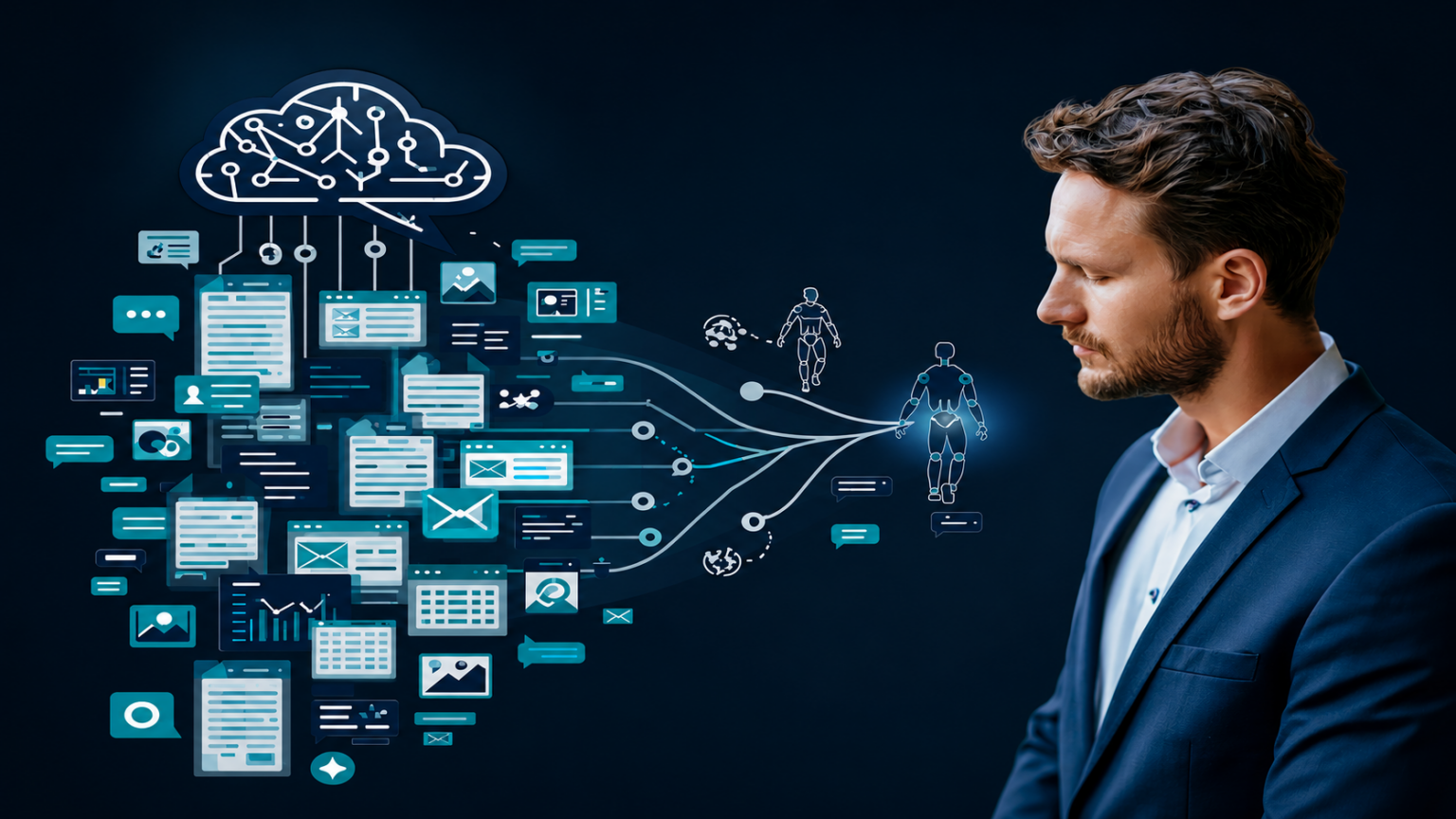

The hidden productivity trap of AI-enabled work, and how composite AI can turn possibility overload into disciplined decision support.
AI was supposed to make knowledge work easier.
In many ways, it has. The blank page is no longer the problem. A rough idea can become a memo, presentation, project plan, or client update in minutes. Research can be summarized, language refined, and scattered information organized with remarkable speed.
But that speed has created a quieter problem. The AI gives you five titles, three structures, two tones, a chart, a social post, and an offer to keep improving all of them. What began as “help me finish this” becomes an hour of comparison, revision, and second-guessing.
This is the hidden productivity trap of AI-enabled work: generative AI reduces the friction of creation, but increases the friction of choice.
That shift should change how leaders think about AI adoption. The next phase will not be defined by who can generate the most. It will be defined by who can build the best systems for deciding what matters.
The AI Vortex

Most professionals do not fall behind because they lack ideas. They fall behind because every idea creates a branching tree of choices.
A lawyer begins with one client update and ends up comparing three tones, two risk summaries, and a proposed visual. A founder begins with one campaign concept and receives five variations. A communications team asks which image best conveys credibility and warmth, then generates ten more images before selecting one.
At first, this feels productive. The machine is moving. The work is improving. Then the AI vortex begins.
If every draft can be refined, when is it finished? If every image can be optimized, which one is best? If every strategy can be reframed, when do you stop reframing and make the decision?
AI has not eliminated judgment. It has made judgment more important.
The professional bottleneck is increasingly not production, but selection, prioritization, and stopping. AI anxiety, in this context, is less about science-fiction fears and more about possibility overload: too many tools, too many outputs, and too many plausible next moves.
From Prompting to Architecture
The problem is not that professionals are using AI too much. It is that they are often using it too linearly.
Most people still treat AI like a prompt box. They ask a question, receive an answer, react to it, request another version, and repeat. That can be useful for brainstorming, but it is not a sustainable operating model for complex work.
A better approach is to move from prompting to architecture.
Enterprise technology teams are already making this shift through composite AI. Oracle describes composite AI as a methodology that combines multiple techniques, including machine learning, natural language processing, knowledge graphs, and rule-based reasoning, to solve problems that are too complex or nuanced for one model alone.
This is where composite AI fits at the personal scale. The goal is not to find the one perfect AI. It is to design a coordinated system in which different models and tools play different roles: Gemini structures a wellness workflow, ChatGPT refines the writing, one model generates the image prompt, another creates the image, and a future domain-specific GPT learns from the architecture of a Metabolic Architect knowledge base. Over time, the AI stack becomes a coordinated team, not a pile of disconnected tools.
That is composite AI in practice: each capability has a defined role inside the system.
Building a Personal Operating System
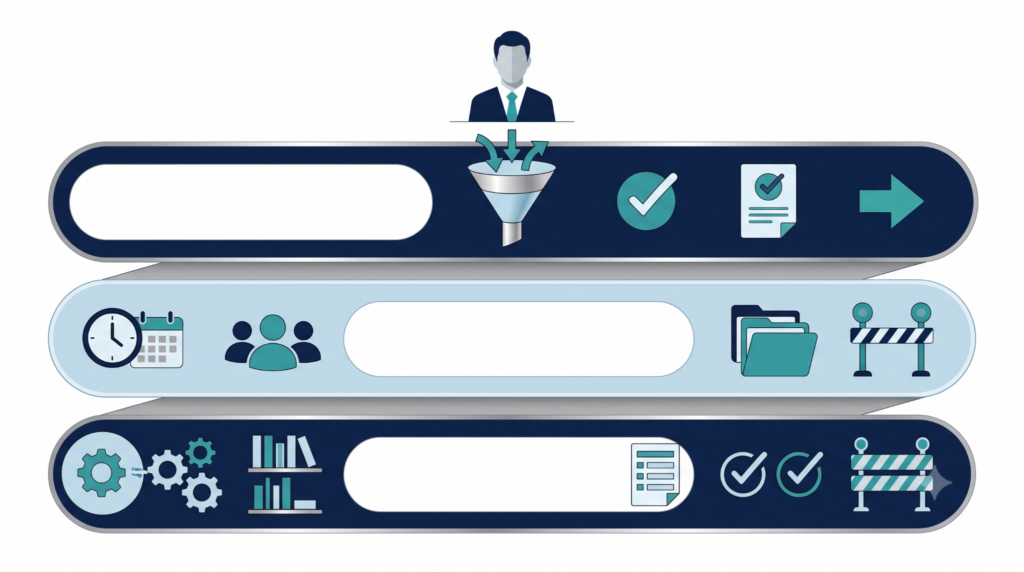
Here, a personal operating system is not another app or a literal computer operating system. It is a structured layer between the individual and the complexity of modern work. It helps filter inputs, apply priorities, enforce standards, and convert scattered information into clear next steps.
A useful system has three layers.
1. The Knowledge Layer
The knowledge layer contains the standards that should not have to be re-explained every time. It may include an executive’s tone of voice, an organization’s templates, audience profiles, brand rules, risk tolerance, approval requirements, strategic priorities, or legal and compliance boundaries.
This layer turns preferences into reusable architecture. Instead of beginning every interaction from zero, the AI starts with a defined operating context.
2. The Context Layer
The context layer contains what is true right now: the deadline, the audience, the available time, the sensitivity of the matter, the documents at issue, the current workload, and the decision that actually needs to be made.
Context changes the answer. A technically excellent client update may still fail if it is too long for the moment, too defensive for the relationship, or too complex for the intended reader.
3. The Orchestration Layer
The orchestration layer combines the standing rules with the live context and directs the workflow toward a usable result.
This is where AI stops behaving like an endless brainstorming partner and starts functioning as decision support. Instead of producing ten possibilities, it identifies the strongest option, explains the rationale, flags the material risk, and recommends the next action.
Without orchestration, AI produces abundance.
With orchestration, AI produces direction.
Productivity Is Direction, Not Production
The most effective AI users are not necessarily the people with the largest prompt libraries or the greatest number of subscriptions. They are the people who know how to direct the workflow.
They know when they need divergent thinking and when they need convergence. They ask for options early, set a stopping rule, and tell the system what “good” means before asking it to generate.
This is the personal application of composite AI: not collecting tools for their own sake, but coordinating capabilities around a decision.
The distinction matters because organizations do not need more content simply because content is easy to generate. They need clearer communication, stronger analysis, faster alignment, and disciplined execution.
AI creates value when it moves work from possibility to action.
Why This Matters for Business Leaders
For business leaders, the personal operating system is more than an individual productivity technique. It is a preview of how AI will enter the enterprise.
Employees are already assembling informal systems across chatbots, search tools, document platforms, image generators, calendars, and internal knowledge sources. Those systems may be highly effective, but they can also be inconsistent, invisible, and difficult to govern.
Organizations should not respond by forcing every use case into one approved chatbot. They should identify the recurring decisions employees are trying to make and design supported workflows around them. A communications workflow may combine brand guidance, audience data, visual analysis, and approval rules. A legal workflow may combine trusted sources, matter context, risk thresholds, and mandatory human review.
The opportunity is not standardization for its own sake. It is to turn individual experimentation into repeatable, governed capability. When organizations understand the architecture behind successful personal workflows, they can preserve flexibility while improving security, reliability, and accountability.
Governance Still Matters
A personal operating system should reduce cognitive overload, not human accountability.
AI can compare options, identify patterns, challenge assumptions, and surface information that a busy professional may have missed. It can strengthen the decision process. It cannot own the decision.
That distinction becomes especially important when AI is used in legal, financial, employment, healthcare, or other consequential settings. The NIST AI Risk Management Framework emphasizes governance, documented responsibilities, and the ongoing management of AI risks. Those principles apply whether the system is enterprise-wide or embedded in an individual executive’s workflow.
Leaders should know which information the system uses, which rules shape its recommendations, what is logged, where human review occurs, and who remains responsible for the outcome.
The relevant question is no longer only, “Can AI perform this task?”
It is also, “How is AI shaping the judgment surrounding this task?”
Five Rules for Designing the System

A personal operating system does not need to be technically elaborate. It needs to be intentional.
1. Define the outcome.
Ask for a decision, recommendation, or finished deliverable, not unlimited exploration.
2. Establish the rules.
Give the system your standards, priorities, constraints, and non-negotiables.
3. Separate creation from selection.
Generate broadly when useful, then switch modes and require the system to rank, justify, and narrow.
4. Preserve human decision rights.
Identify the choices that require professional judgment, accountability, or values that cannot be delegated.
5. Document what works.
Reusable instructions, templates, and approval rules turn one successful interaction into an operating capability.
The goal is not to remove every decision from human hands. It is to reserve human attention for the decisions that deserve it.
Final Takeaway
The cure for AI anxiety is not another model, another prompt library, or another stream of possibilities.
It is better architecture.
When AI is used as an open-ended prompt box, it can become another source of noise. When it is designed as a personal operating system, it can organize information, narrow options, reinforce standards, and help people move from possibility to action.
The future of AI is not simply faster work.
It is better thinking.
And the organizations that understand that shift will not merely automate more tasks. They will build systems that help humans decide what work matters.
Read More from Anant
- AI Enhances, Not Replaces: A Human-Centered Future
- From Data to Decisions: How AI Augments Human Insight
- How to Talk to AI Vendors (Without Being an AI Tourist)
Sources and Further Reading
- Harvard Business Review: How People Are Really Using AI in 2026
- Oracle: What Is Composite AI?
- NIST: AI Risk Management Framework
About the Author
Lili Kazemi is General Counsel and AI Policy Leader at Anant Corporation, where she advises on the intersection of global law, tax, and emerging technology. She brings more than 20 years of combined experience from leading roles in Big Law and Big Four firms, with a deep background in international tax, regulatory strategy, and cross-border legal frameworks. Lili is also the founder of The Human Edge of AI and DAOFitLife, a wellness and performance platform for high-achieving professionals navigating demanding careers.
Follow Lili on LinkedIn and X.
About Anant
At Anant, we help forward-thinking teams unlock the power of AI safely, strategically, and at scale. From legal to finance, our experts guide you in building workflows that act, automate, and aggregate without losing the human edge. Let’s turn emerging technology into your next competitive advantage.
Follow Anant on LinkedIn | Subscribe to The Human Edge of AI