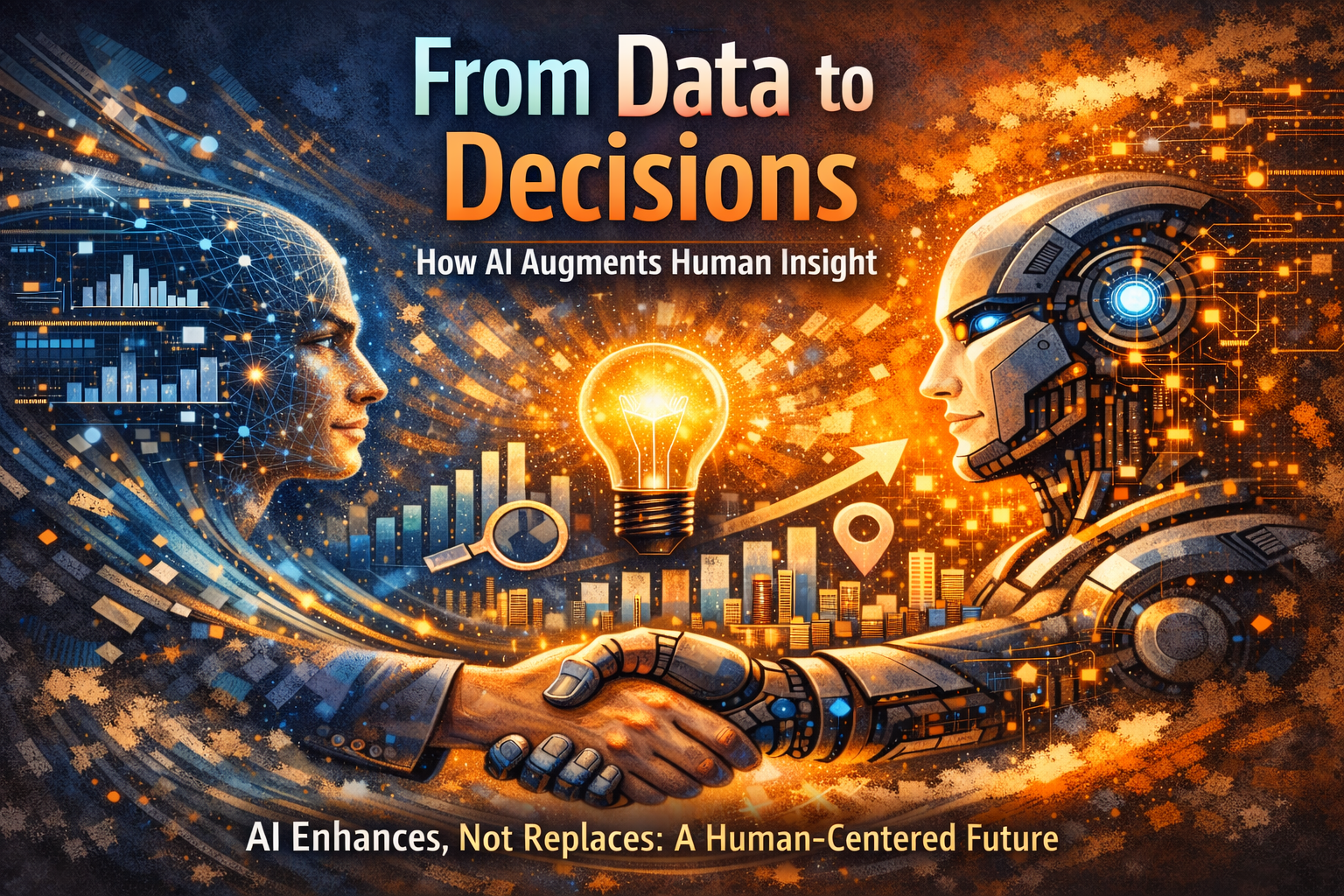

Part of the “AI Enhances, Not Replaces: A Human‑Centered Future” series
We live in a world overflowing with data. Every click, transaction, sensor reading, and conversation generates information. Yet despite this abundance, many organizations still struggle with a familiar problem: turning data into decisions. Data by itself is inert. Insight requires interpretation, context, and judgment – qualities that remain deeply human. This is where artificial intelligence (AI) is reshaping the decision landscape, not by replacing people, but by amplifying their ability to see clearly and act wisely.
The Challenge Isn’t Data Scarcity – It’s Sense-Making
Recent market trends show that companies are investing heavily in AI-powered analytics, forecasting, and decision-support tools. According to industry reports from 2024 and 2025, organizations that use AI to support decision-making report faster response times, improved accuracy, and better risk management. But the same reports also highlight a critical insight: the highest-performing organizations keep humans firmly “in the loop.”
Why? Because decision-making is not just a computational task. It involves trade-offs, ethics, uncertainty, and strategic intent. AI can surface patterns and probabilities, but it cannot fully grasp organizational culture, regulatory nuance, or human impact. Data becomes valuable only when humans apply meaning to it.
AI’s Real Strength: Turning Noise into Signal
AI excels at what humans find hardest: processing scale and complexity. Modern AI systems can analyze millions of data points in real time, detect subtle correlations, and simulate future scenarios. In volatile markets from supply chains disrupted by geopolitical shifts to rapidly changing consumer behavior — this capability is invaluable.
For example, AI can identify emerging demand trends weeks earlier than traditional reporting, flag operational anomalies before they escalate, or model thousands of potential outcomes from a single strategic decision. What it delivers is clarity — a distilled view of what matters most.
But clarity is not the same as certainty. AI does not decide what should be done; it informs humans so they can decide what makes sense.
Human Judgment: Still the Deciding Factor
Human insight remains essential at every critical decision point. Leaders bring contextual understanding: knowledge of brand values, long-term strategy, employee morale, customer trust, and ethical responsibility. These are not variables that can be fully encoded into algorithms.
In practice, this means humans ask questions AI cannot:
- Does this recommendation align with our mission?
- What are the second-order consequences?
- How will this decision affect people, not just metrics?
In healthcare, for instance, AI can flag potential diagnoses or treatment options, but clinicians decide what is appropriate for a specific patient. In finance, AI models assess risk, but executives choose how much risk the organization is willing to take. In hiring, AI can screen candidates, but humans judge cultural fit and potential.
AI accelerates insight; humans provide wisdom.
A New Decision Cycle Emerges
The integration of AI into decision-making is creating a new operating rhythm:
- Data aggregation – AI continuously ingests data from diverse sources.
- Insight generation – Models identify trends, risks, and opportunities.
- Human interpretation – Experts contextualize insights using experience and values.
- Action and feedback – Decisions are executed, outcomes measured, and learning fed back into systems.
This cycle is faster, more adaptive, and more resilient than traditional approaches. Importantly, it transforms decision-making from a one-time event into a continuous learning process.
Market Reality: Augmentation Outperforms Automation
Recent enterprise adoption trends show a clear pattern: organizations that frame AI as a decision partner outperform those that treat it as an autonomous decision-maker. Over-automation often leads to brittle systems and blind trust in outputs. Augmentation, on the other hand, creates transparency, accountability, and better outcomes.
As a result, new roles are emerging – decision translators, AI governance leaders, and domain experts who specialize in interpreting model outputs. These roles sit at the intersection of data, technology, and human judgment, reinforcing the idea that AI increases the value of human expertise rather than diminishing it.
Conclusion: Better Decisions, Not Fewer Humans
The story of AI is often told as a story of replacement. But in reality, its most powerful impact is augmentation. AI helps humans move from data overload to decision clarity. It reduces guesswork, surfaces hidden insights, and expands our cognitive reach.
Yet the final responsibility – deciding what to do and why remains human.
In the journey from data to decisions, AI is not the decision-maker. It is the lens that sharpens human insight. And in a world defined by complexity and change, that partnership may be the most valuable intelligence of all.