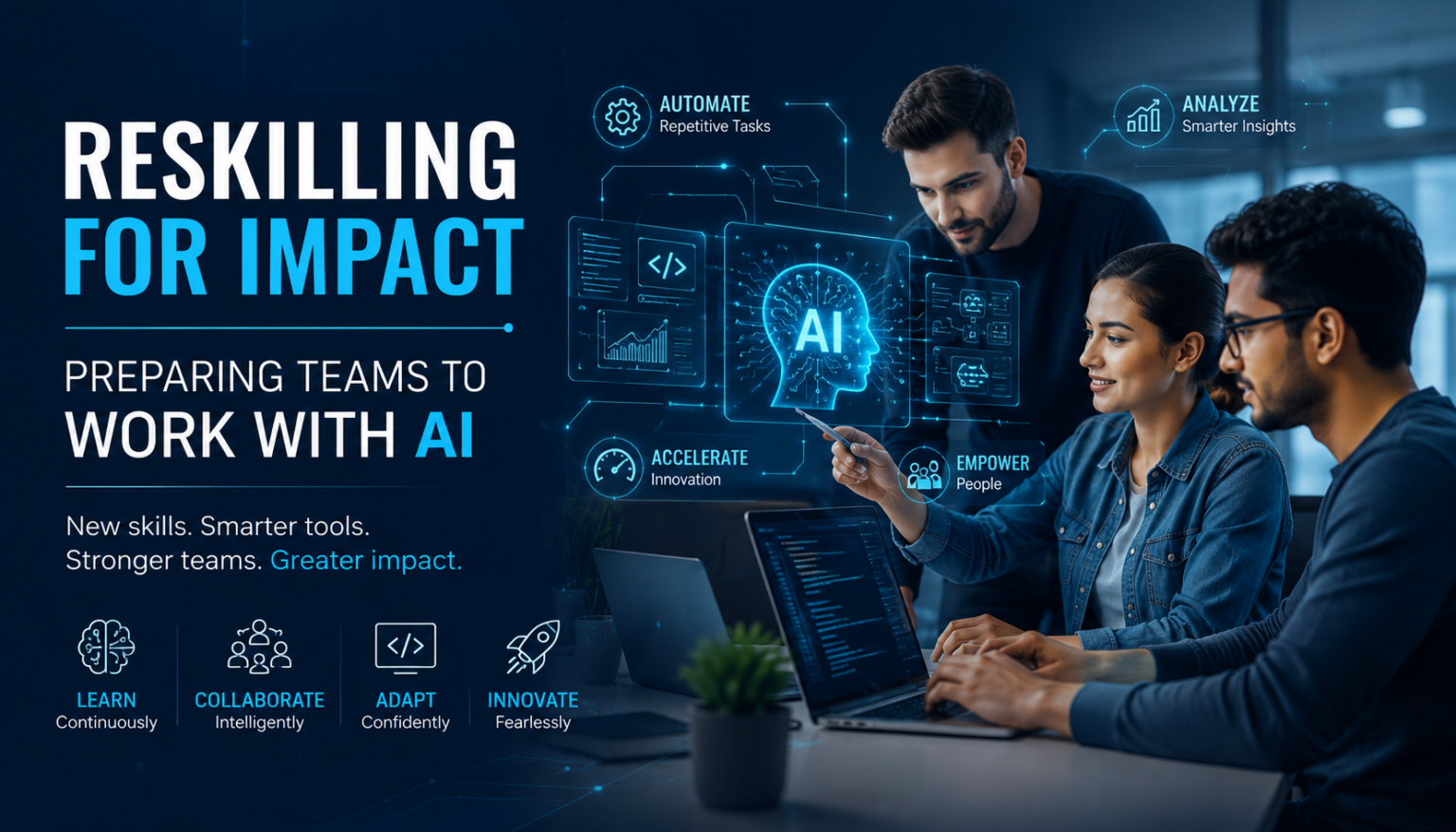

Artificial Intelligence is rapidly reshaping the technology industry. From software development and cybersecurity to cloud operations and data analytics, AI is becoming deeply integrated into how modern tech teams work. But despite fears surrounding automation, one reality is becoming increasingly clear: AI is enhancing human capability, not replacing it.
The real transformation is not about machines taking over jobs — it is about professionals learning how to work smarter with intelligent systems.

In today’s tech-driven environment, AI tools can generate code snippets, detect vulnerabilities, automate testing, predict system failures, and analyze massive datasets within seconds. Developers now use AI coding assistants to accelerate programming tasks, while IT teams rely on AI-driven monitoring systems to maintain infrastructure more efficiently.
However, these tools still require human direction, creativity, and critical thinking. AI may write code, but engineers still design architectures. AI can identify patterns, but analysts still make strategic decisions. The future belongs to professionals who understand how to combine technical expertise with AI capabilities.
From Resistance to Readiness

One of the biggest barriers to AI adoption is fear. Employees often worry:
- Will AI replace my role?
- Will I become irrelevant?
- Do I need to become a programmer now?
The answer to the last question is usually no.
Most employees don’t need advanced coding skills. They need confidence using AI tools in everyday workflows. The goal is not to turn everyone into AI engineers — it’s to make AI feel approachable, practical, and valuable.
Forward-thinking organizations are already investing heavily in this shift. Companies are integrating AI training into daily work culture through workshops, collaborative learning, and AI-assisted productivity tools.
And the smartest leaders know reskilling isn’t a one-time event. It’s an ongoing mindset.
Why Reskilling Matters in the Tech Industry
Technology evolves quickly, and skills can become outdated within just a few years. The rise of AI has accelerated this cycle even further. Organizations that fail to reskill employees risk falling behind in innovation, productivity, and competitiveness.
Reskilling helps tech teams:
- Adapt to AI-powered workflows
- Improve productivity and collaboration
- Reduce repetitive manual tasks
- Strengthen problem-solving abilities
- Stay relevant in a rapidly changing industry
Most importantly, reskilling reduces fear. Employees become more confident when they understand that AI is a tool designed to support their work rather than eliminate their value.

The Skills Teams Need in the AI Era
Modern tech professionals need more than coding knowledge. AI-driven workplaces demand a combination of technical and human-centered skills.
Essential AI-era skills include:
- AI literacy – understanding how AI models and tools work
- Prompt engineering – effectively interacting with AI systems
- Data interpretation – validating AI-generated insights
- Cybersecurity awareness – managing AI-related security risks
- Critical thinking – identifying inaccurate or biased AI outputs
- Adaptability – continuously learning new technologies
Soft skills are equally important. Communication, teamwork, leadership, and ethical decision-making remain areas where humans outperform machines.
For example, an AI tool might suggest hundreds of possible solutions to a system issue, but experienced engineers still decide which solution is practical, secure, and scalable for real-world implementation.
Building an AI-Ready Tech Culture
Successful organizations are not treating AI learning as optional anymore. They are embedding continuous learning into company culture.
Tech companies are investing in:
- Internal AI workshops and bootcamps
- Cloud and AI certification programs
- Hands-on experimentation with AI tools
- Cross-functional innovation teams
- AI ethics and governance training

A strong AI-ready culture also encourages experimentation without fear of failure. Teams should feel comfortable exploring AI tools, testing ideas, and improving workflows collaboratively. Innovation grows faster when learning becomes part of everyday work rather than a one-time training event.
Another critical aspect is ethical AI adoption. As organizations increasingly depend on AI systems, employees must understand issues like algorithmic bias, privacy concerns, transparency, and responsible data usage. Technical expertise without ethical awareness can create serious long-term risks.
Conclusion
The rise of AI is not signaling the end of human contribution in technology — it is redefining it. Tech professionals who embrace continuous learning and AI collaboration will become more valuable, not less.
In the coming years, the strongest organizations will not simply be those with the most advanced AI systems. They will be the ones with teams capable of using AI creatively, responsibly, and strategically.
AI may power the future, but people will continue to lead it.
The Anant Advantage
The AI industry produces an endless stream of advice:
- Become indispensable
- Learn AI
- Reinvent yourself
- Adapt faster
But knowing about AI is different from knowing how to work with it.
Real transformation happens through:
- Testing workflows
- Learning systems directly
- Understanding outputs
- Building judgment through use
- Integrating AI into real operational environments
At Anant Corporation and Intelcraft, we believe enablement matters more than information overload.
The goal is not simply to educate people about AI.
The goal is to help them develop real capability with it.
Because the future belongs not just to people who understand AI conceptually, but to those who can apply it effectively in the real world.