
By Lili Kazemi, General Counsel & AI Policy Leader at Anant Corporation
Originally published on Anant Blog | Cross-posted to LinkedIn
🎬 A New Kind of Creative Rush
Since September 30, I’ve been experimenting with Sora, OpenAI’s text-to-video platform. As someone who’s built content pipelines the traditional way—storyboarding, scripting, shooting, editing—the experience of typing a prompt and watching a cinematic video render in seconds still feels a bit like sorcery.
What normally takes hours (or days) to plan, film, and polish can now be imagined, generated, and iterated in minutes. It’s exhilarating—and a little unsettling.
Over the past year, Sora has moved from a promising text-to-video tool to a full-fledged creative platform. The original Sora model allowed for short cinematic clips—up to 20 seconds at launch—with basic prompt-to-video capabilities. In September 2025, Sora 2 went live: more physically accurate, better at simulating real-world physics, improved audio-video alignment, and “cameo” insertion of real people. Alongside this, OpenAI introduced a higher-tier “Pro” version for ChatGPT Pro subscribers, offering longer generation times, multi-shot storyboards and priority compute. The shift signals that AI-video is no longer a novelty—it’s entering the workflow of creators, brands and legal stakeholders.
Sora gives us what every creator secretly craves: the ability to actualize an idea instantly. And yet, like any zero-friction tool, it comes with trade-offs that go deeper than technical quality or frame rate.
🪞 The Aesthetics of Almost-Real
One of the first things I noticed was how hyper-real Sora’s world feels. It isn’t that the renderings are cartoonish—far from it. The lighting, movement, and cinematic detail are stunning. But there’s a certain uncanny precision that tells you it’s not human-shot.
Even when I’m meticulous in my cameo prompts—specifying wardrobe, lighting, even facial structure—the end product still bends toward idealization.
- My proportions sometimes look subtly enhanced,
- The textures are smoother than reality allows,
- The environment feels too balanced, too symmetrical.
It’s realism as aesthetic ideal, not realism as truth.
And that, I think, is the frontier question Sora raises: What does “authentic” mean when the artifact looks better than the original?
🤖 Governance, Consent, and the Human Factor
The release of OpenAI’s new Sora guidelines—which let creators control how their likeness or content are used and even monetize opt-ins—marks a necessary evolution.
I’ve felt firsthand how personal this gets. When your digital likeness can appear, speak, or even emote without you recording it, governance becomes identity protection. Setting boundaries is no longer a legal formality; it’s a creative safety net.
I even took it up with the boss:
At first, I worried that parameters might limit spontaneity. But in practice, they enable trust. Being able to cameo fellow creators responsibly—Rahul Singh and I have been exploring this in our Human Edge of AI x DAOFitLife experiments—has made Sora less about replacement and more about collaboration.
The more control creators have, the more ethical innovation becomes.
⚙️ The Texture of Synthetic Reality

Here’s where the metaphor crystallized for me.
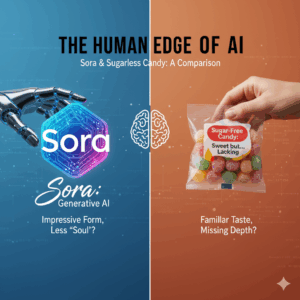
Sora is like sugarless candy.
The resemblance is uncanny:
- It satisfies a craving.
- It feels indulgent but light.
- It’s engineered to mimic the real thing.
But somewhere between flavor and aftertaste, your senses realize it’s a simulation. You might love it—many of us do—but you know instinctively there’s a ceiling to how real it can ever feel.
That’s Sora in a nutshell. The dopamine hit of instant creation is real. The fulfillment it offers, though, sits just one layer below the genuine high of making something the hard way.
When you film, you sweat the angles, wait for light, trip over cords, reshoot dialogue. It’s messy and time-consuming, but it’s alive. Sora, by contrast, delivers perfect imperfection—a chemical substitute for creative chaos.
🧠 The Psychology of Effortless Creation

Humans bond to process, not just results.
Our sense of ownership grows from struggle: the rough drafts, retakes, and late-night edits that forge emotional attachment to the final cut.
When that friction disappears, creativity feels more like consumption than authorship.
This doesn’t make Sora less valuable—it just makes it a different category altogether. Think of it as idea prototyping for the visual cortex. You can externalize concepts faster, test moods, stage metaphors, and preview narratives before investing in full production.
It’s like having a mental whiteboard that moves.
And once you realize that, the question shifts from “Is this real?” to “What can this free me to do next?”
🌐 The Democratization Dividend
Another thing I’ve learned: Sora lowers the barrier to entry for creators who have imagination but not infrastructure. You no longer need a camera crew, lighting rig, or editing suite to visualize a story.
That’s a revolution for educators, small businesses, and solo innovators. It’s also why governance matters so much—because accessibility without accountability invites misuse.
For professionals, it means re-examining authenticity as a leadership skill. In a world where anyone can project cinematic authority, credibility will hinge on intent and transparency, not production value.
🧩 Imperfection as a Feature
I used to wish my Sora cameos looked more like me—less symmetrical, less “ideal.” Now I see those imperfections as markers of humanity. The slight exaggerations remind me that AI is an interpretive mirror, not a clone.
The gap between what it renders and what I recognize keeps me grounded.
It whispers: You’re still the original.
That awareness actually enhances creativity. I can storyboard ideas visually, then re-humanize them in editing or live performance. The friction between synthetic and real sparks new artistic energy.
⚖️ Entertainment, Education, and Escape
So what’s the real purpose of Sora? I’ve come to believe it sits at the intersection of three needs:
- Entertainment – play, humor, experimentation.
- Education – learning through visualization and storytelling.
- Escape – a healthy outlet for creativity in compressed time.
Used consciously, it’s not a threat to “real” filmmaking or writing—it’s a training ground for imagination.
And for me personally, I find it really helpful to get my message in DAOFitLife life out there in very fun and educational videos I would normally not have time to make unless I was a full time influencer and as I have made extremely clear in my mission statement I am not a fit influencer I am someone who has gained expertise in the art of corporate Wellness and is using that to share knowledge with likely situated like minded individuals in the community
Every time I use it, I’m reminded that creativity doesn’t live in pixels or prompts; it lives in the decision to make something new.
And I never have to worry about exactly how a tripod is positioned or interrupting someone else’s view or workout or asking random strangers to film me or spending countless hours editing. I view all of that as a self indulgent waste of time. We are here to live and experience life not film it all the time. With the ability to use my creativity and tell stories through Sora it gives me the best of all of these worlds.
I know it’s not the real candy but it sure has that kick.
💬 The Sugarless Candy Test
The next time you use Sora—or any generative tool—ask yourself:
Does this taste good because it’s sweet, or because it’s mine?
Sugarless candy can satisfy, even delight, but it doesn’t metabolize like sugar. The body knows the difference. In the same way, our creative instincts can tell when something is almost-but-not-quite human.
That awareness isn’t a flaw; it’s a safeguard. It keeps us striving for the moments when art transcends efficiency—when it feels alive.
🔍 Looking Ahead
AI video is evolving faster than any medium in history. The next wave will blur lines even more—integrating speech, gesture, and dynamic emotion. That makes it urgent for creators, companies, and policymakers to align on three principles:
- Consent: Every likeness deserves control.
- Context: Synthetic realism should always carry disclosure.
- Credit: Creative labor, even algorithmic, has value.
These aren’t just legal issues—they’re cultural ones. They determine how comfortable we’ll feel inhabiting this new mixed-reality space.
🧠 Final Reflection
Sora may never taste exactly like the “real thing,” but maybe that’s the point. The value isn’t in replication—it’s in liberation.
By lowering the cost of experimentation, it frees human creators to focus on what machines can’t: nuance, humor, empathy, moral imagination.
The sugarless candy doesn’t replace dessert—it lets you enjoy it more consciously.
Lili Kazemi is General Counsel and AI Policy Leader at Anant Corporation, where she advises on the intersection of global law, tax, and emerging technology. She brings over 20 years of combined experience from leading roles in Big Law and Big Four firms, with a deep background in international tax, regulatory strategy, and cross-border legal frameworks. Lili is also the founder of DAOFitLife, a wellness and performance platform for high-achieving professionals navigating demanding careers.
Follow Lili on LinkedIn and X

🔍 Discover What We’re All About
At Anant, we help forward-thinking teams unlock the power of AI—safely, strategically, and at scale.
From legal to finance, our experts guide you in building workflows that act, automate, and aggregate—without losing the human edge.
Let’s turn emerging tech into your next competitive advantage.
Follow us on LinkedIn
👇 Subscribe to our weekly newsletter, the Human Edge of AI, to get AI from a legal, policy, and human lens.
Subscribe on LinkedIn
Tune into the The Human Edge of AI for a deeper dive into the ethics of creator control, monetization, and how Sora’s new policy framework could shape the next era of human-machine collaboration.
#AI #HumanEdgeofAI #DigitalEconomy #Innovation #Governance #Creativity #Leadership #OpenAI #Sora #Anant #SmarterTechStrongerHumans
DAOFitLife is a revolutionary fitness and wellness platform that empowers individuals to take control of their health and well-being through the principles of decentralized autonomous organizations (DAOs). Our mission is to create a community-driven ecosystem that promotes holistic fitness, personalized nutrition, and sustainable lifestyle choices. By leveraging the power of blockchain technology, we provide our members with transparent, secure, and equitable access to a wide range of fitness resources, expert guidance, and innovative wellness solutions. At DAOFitLife, we believe that true well-being is a collective journey, and we are committed to fostering a supportive and inclusive environment where everyone can achieve their health goals and live their best lives. Visit daofit.life to learn more.