

Part of the “AI Enhances, Not Replaces” Series
Artificial Intelligence is no longer an experimental edge – it’s becoming the operational backbone of modern enterprises. In 2026, organizations are no longer asking “Should we use AI?” but “How do we scale it responsibly?”
The real challenge isn’t adoption – it’s scaling intelligence without losing control.
🚀 The Shift: From Experimentation to Execution
In early 2026, a clear pattern has emerged: AI success depends less on technology and more on execution. Many organizations report that AI initiatives stall not because of weak models, but due to poor understanding, lack of governance, and unclear strategy.
At the same time, enterprise investment is skyrocketing, with projections estimating hundreds of billions of dollars flowing into AI infrastructure in 2026 alone.
Yet, scale without structure leads to chaos.
⚠️ The Hidden Risk of Scaling AI Too Fast
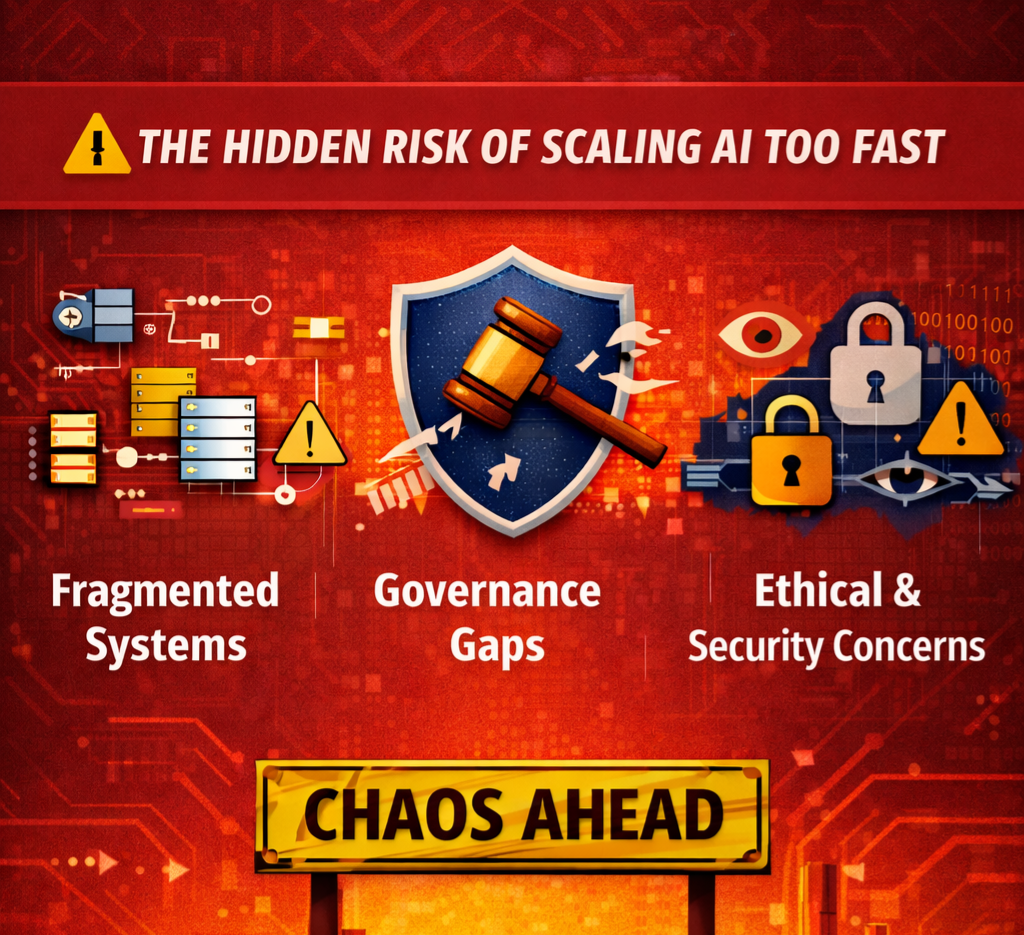
As organizations rush to scale AI, three major risks emerge:
1. Fragmented Systems
Disconnected data, duplicated tools, and isolated AI pilots prevent consistent outcomes and measurable ROI.
2. Governance Gaps
AI governance is now as critical as financial governance. Without it, trust erodes quickly.
3. Ethical and Security Concerns
Data privacy, bias, and misuse risks can derail even the most promising AI initiatives.
Scaling AI without addressing these issues is like building a skyscraper on an unstable foundation.
🧠 What “Scaling Intelligence” Really Means
Scaling AI isn’t about deploying more model – it’s about building intelligent systems that operate reliably, transparently, and at scale.
In 2026, leading organizations are shifting toward:
- Unified AI architectures (data + models + workflows integrated)
- Human-in-the-loop systems for accountability
- Closed-loop learning where outcomes improve future decisions
- Operational AI embedded into business processes
AI maturity is now measured by how effectively organizations convert data into accountable, real-world decisions.
🏗️ The 4 Pillars of Controlled AI Growth
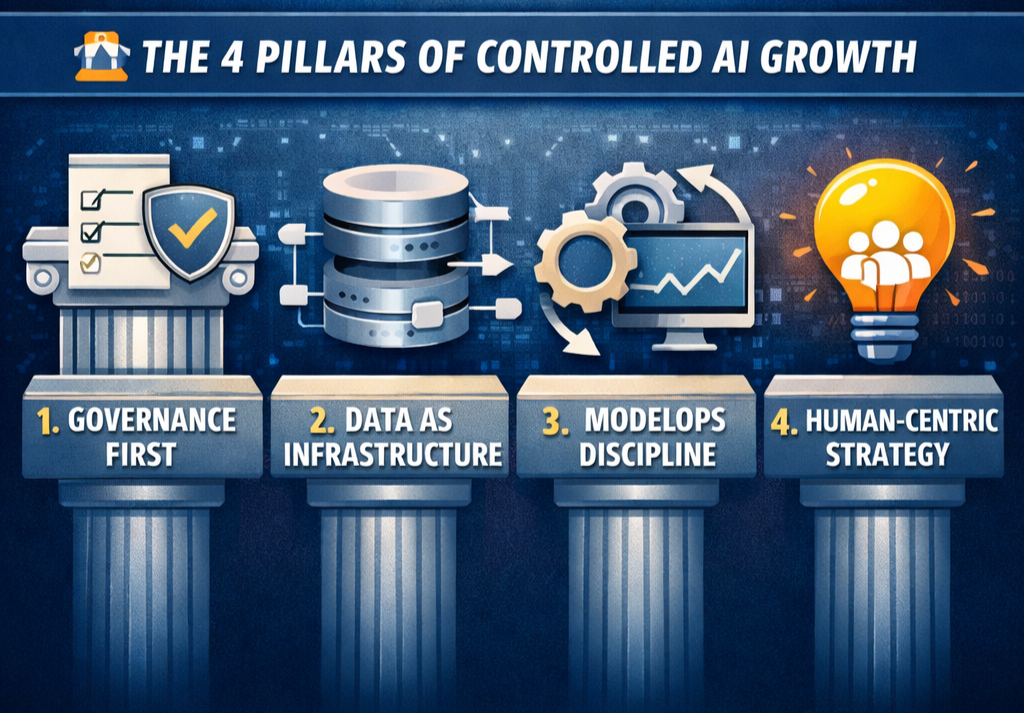
1. Governance First, Not Last
AI governance is becoming a core operating layer, not an afterthought. It defines how systems are approved, monitored, and audited.
2. Data as Infrastructure
Scalable AI depends on clean, unified, and accessible data ecosystems. Fragmented data leads to fragmented intelligence.
3. ModelOps & Lifecycle Discipline
Organizations are adopting lifecycle practices to manage deployment, monitoring, and continuous improvement of AI systems.
4. Human-Centric Strategy
The most successful companies focus on enhancing human decision-making and not replacing it.
🌍 A 2026 Reality Check: Adoption vs. Readiness
Despite massive investment, AI adoption remains uneven across industries. Many organizations are still struggling to move from experimentation to full-scale deployment.
Even in advanced markets, enterprises are slower than consumers in adopting AI at scale – highlighting that the challenge is not technological, but organizational.
🔑 How to Scale Without Losing Control
To truly scale intelligence, organizations must balance speed with structure:
✔ Build a Unified AI Operating Model
Align data, tools, governance, and business goals into one cohesive system.
✔ Invest in Trust and Transparency
Explainable AI and clear audit trails build confidence across teams and customers.
✔ Start Small, Scale Smart
Pilot with purpose but design systems that can scale from the beginning.
✔ Embed AI into Workflows, Not Dashboards
AI should drive decisions not just provide insights.
✨ Final Thought
The future of AI isn’t about replacing humans – it’s about amplifying intelligence across the organization.
The companies that succeed in 2026 and beyond won’t be the ones with the most AI tools…
They’ll be the ones who scale AI with discipline, governance, and purpose.
Because in the end:
Control isn’t the opposite of scale – it’s what makes scale possible.