
By Lili Kazemi | Founder, The Human Edge of AI
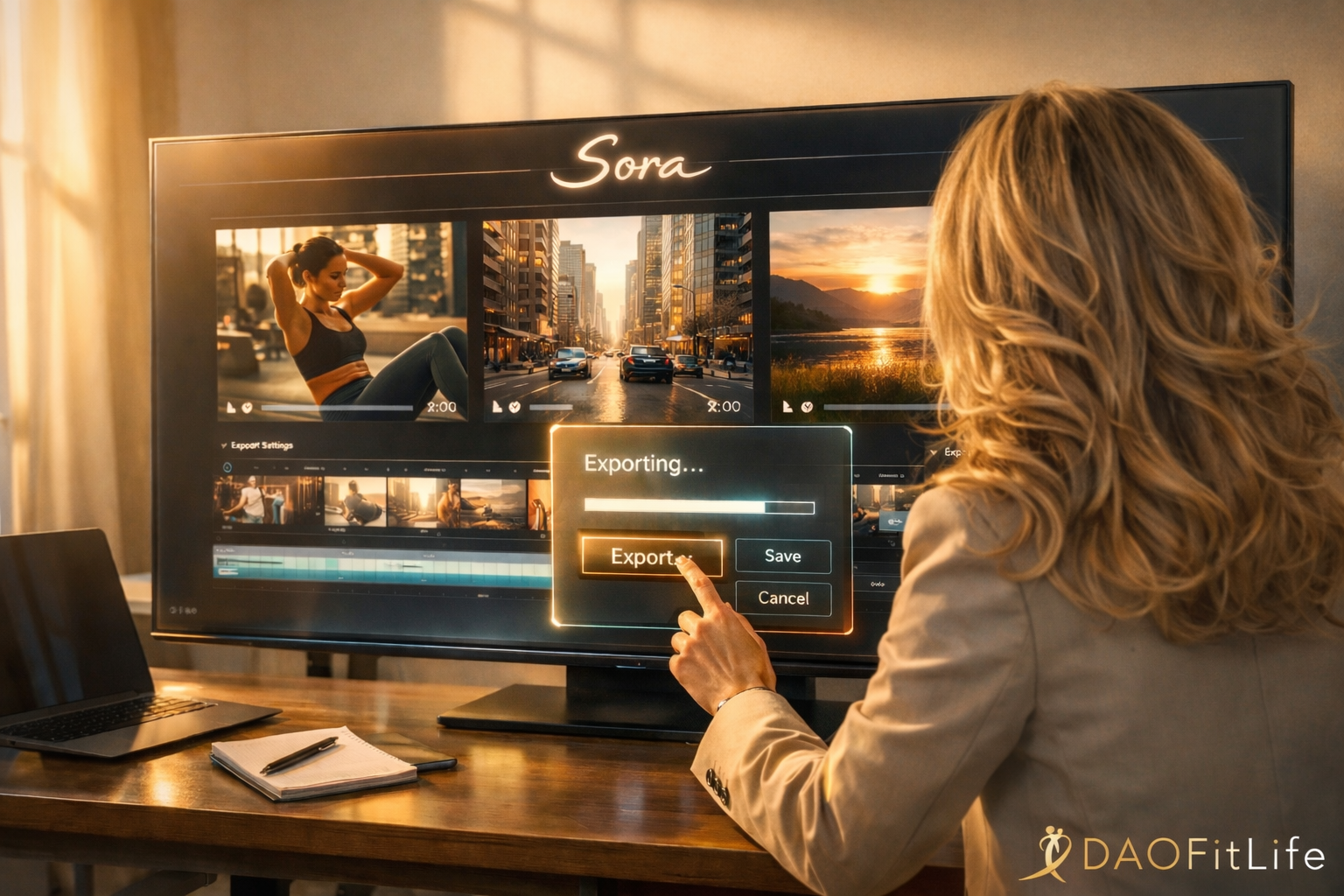
OpenAI is shutting down the Sora web and app experience on April 26, 2026, with the API following on September 24, 2026.
Which means this is not theoretical anymore.
If you’ve used Sora—or any AI video platform—this is your window to:
- preserve your work
- organize your assets
- and make sure nothing you created disappears with the product
This is not a think piece.
This is a playbook.
First: What I’m Doing (Real Workflow)
I’ve been using Sora for DAOFitLife to create short-form, visual-first content around fitness and routines.
Not random clips—structured ideas.
Think:
- quick workout flows
- routine visualization
- concept videos for posts like The One-Click Workout
Because here’s the reality:
A picture is worth 1,000 words. A video is worth the entire workflow.
If I show someone:
- the sequence
- the pacing
- the transitions
They don’t just understand it.
They do it.
That’s the difference.
So here’s exactly what I’m doing right now before the shutdown:
1. Publishing everything outward
I’m pushing my Sora-generated content to:
- Instagram Reels
- YouTube Shorts
- Any platform where it can live independently of the tool
Because once it’s out there, it’s no longer dependent on Sora.
2. Downloading all master files
Every usable video is being downloaded in highest quality.
No exceptions.
3. Creating a structured Google Drive archive
Everything is going into a clean folder system so I can:
- reuse it
- repurpose it
- rebuild from it later
That is the difference between using AI casually and using it professionally.
The Core Rule Going Forward
This is the lesson people miss:
The model is not your asset. Your output is.
If you don’t export it, organize it, and store it—you don’t own your workflow.
Your 10 Day Action Plan
If you’ve used Sora (or anything like it), do this now.
Step 1: Export Everything
- Download all videos in highest quality (MP4, H.264/H.265)
- Keep both final versions and earlier iterations if they matter
- Use mass export first (recommended): OpenAI offers a bulk export option via Settings → Data Controls → Export Data, allowing you to download your full Sora archive before doing manual cleanup
Step 2: Capture Your Metadata
- Prompts
- Parameters
- Model versions
- Captions/subtitles
This is how you recreate your work later.
Step 3: Save Clean Versions
- Keep watermark-free exports if available
- Store preview versions separately for quick use
Step 4: Log Your Inputs
- Music
- Images
- Fonts
- Any licensed material
Save receipts or screenshots of licenses.
Step 5: Organize Your Work
- Scripts
- Storyboards
- Project files
Add a simple README so you know what everything is later.
Step 6: Back It Up Twice
- Primary location (Drive or local)
- Secondary backup (external or separate cloud)
And actually check that the files open.
Step 7: Lock in Your Final Versions
- Save “final” outputs clearly labeled
- Keep links to where they’re published
Copy/Paste Folder Structure
/AI_VIDEO_PROJECT
/01_MASTERS
/02_METADATA
/03_PROJECT_FILES
/04_ASSETS
/05_LICENSES
/06_EXPORTS
/07_BACKUP_LOG
README.txt
The Fitness Angle (Why This Matters More Than People Think)
Fitness content is one of the clearest examples of why AI video matters.
Because it’s not just about information.
It’s about execution.
You can tell someone:
- do 4 exercises
- 3 circuits
- 10 reps each
But until they see it, it’s abstract.
Video removes friction.
And AI video reduces the cost of creating that clarity.
That’s why I used Sora the way I did.
Not to replace training or coaching.
But to:
- show movement clearly
- reinforce routines
- make content more actionable
That is not noise.
That is utility.
Quick Legal Reality Check
From a General Counsel perspective, this is simple:
Do not build your entire system on one platform.
Sora worked. And now it’s going away.
That’s not unusual.
What matters is whether you prepared for it.
Going forward:
- diversify tools
- export everything
- keep control of your outputs
Because your IP is not the model.
It’s what you create with it.
What Happens Next
AI video is not going anywhere.
What’s changing is:
- where it lives
- how it’s delivered
- who controls the workflow
And importantly, there are already multiple platforms stepping in—which is exactly why this is not a dead category.
Here’s how to think about the current landscape:
1. Platforms already inside broader AI ecosystems
- ChatGPT (OpenAI) → While Sora as a standalone product is being shut down, video generation capabilities are increasingly being folded into broader AI experiences. Expect video to reappear as a feature, not a separate app.
- Google (Veo) → Google’s Veo models are pushing high-quality, cinematic video generation with strong integration potential across YouTube and creator tools.
2. Creator-first video platforms
- Runway → One of the strongest tools for creators. Focuses on editing, control, and real workflows—not just generation.
- Pika → Faster, more social-friendly outputs. Good for short-form content and rapid iteration.
3. Emerging high-performance models
- Kling (China) → Known for realistic motion and longer-form generation. Part of the broader global expansion of AI video capability.
- Open-source / MIT-style models (e.g., GLM variants) → More flexible, potentially less restricted, but require more technical setup.
4. What this actually means for you
We are moving from:
- one dominant demo product
To:
- a fragmented but more practical ecosystem
Where different tools will specialize in:
- realism
- editing control
- speed
- distribution
And this is where your advantage comes in.
Because if you already know how to:
- structure content
- direct visuals
- maintain a consistent brand
You are not starting over.
You are just switching instruments.
Final Take
You have 10 Days.
Use them.
Export your work.
Organize your assets.
Publish what matters.
Because once the platform goes away, your only leverage is what you saved.
And the people who treat this like infrastructure—not a toy—are the ones who will be able to keep building without interruption.
***
Lili Kazemi is General Counsel and AI Policy Leader at Anant Corporation, where she advises on the intersection of global law, tax, and emerging technology. She brings over 20 years of combined experience from leading roles in Big Law and Big Four firms, with a deep background in international tax, regulatory strategy, and cross-border legal frameworks. Lili is also the founder of DAOFitLife, a wellness and performance platform for high-achieving professionals navigating demanding careers.
Follow Lili on LinkedIn and X
👇 Subscribe to Lili’s newsletter, the Human Edge of AI, to get AI from a legal, policy, and human lens.
Subscribe on LinkedIn